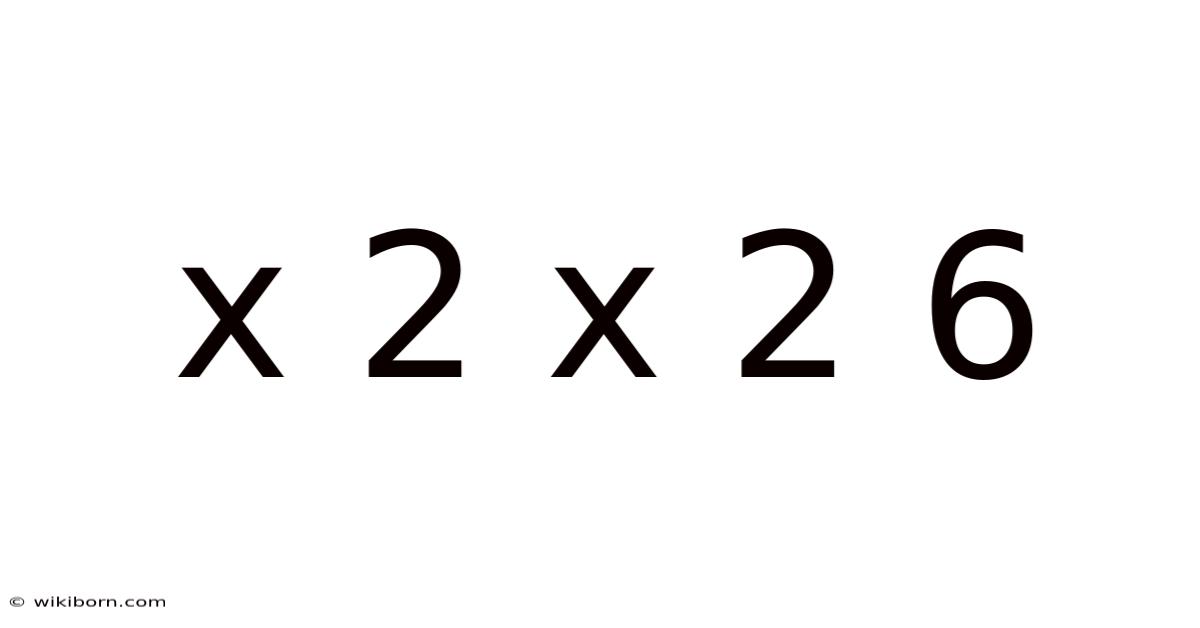
Decoding the Mystery: Exploring the Mathematical and Logical Implications of "x 2 x 2 = 6"
This seemingly simple equation, "x 2 x 2 = 6," presents a fascinating puzzle that looks at the realms of algebra, logic, and even the philosophy of mathematics. That said, a deeper exploration reveals several intriguing interpretations and approaches to understanding its implications. Practically speaking, at first glance, it appears unsolvable within the standard rules of arithmetic. This article will investigate the various perspectives on this equation, examining its mathematical impossibility within standard algebra, exploring potential solutions within alternative mathematical frameworks, and considering its implications for logical reasoning and problem-solving.
The Apparent Impossibility: A Standard Algebraic Approach
In standard algebra, the equation "x 2 x 2 = 6" is presented as a challenge to find a single numerical value for 'x' that satisfies the equation. Let's break it down:
-
Standard Order of Operations (PEMDAS/BODMAS): The order of operations dictates that multiplication is performed from left to right. That's why, the equation should be interpreted as (x * 2) * 2 = 6. This simplifies to 4x = 6.
-
Solving for x: To isolate 'x', we divide both sides of the equation by 4: x = 6/4 = 3/2 = 1.5 It's one of those things that adds up. Still holds up..
That said, this solution appears to contradict the original problem statement, which implies a simpler, whole-number solution might be sought. The key lies in understanding that the equation, as written, adheres strictly to standard algebraic conventions. That said, this reveals the inherent ambiguity in the presentation of the problem. The use of only one multiplication symbol, "x", could cause confusion or an unintended lack of clarity in interpreting the problem itself Small thing, real impact..
Not the most exciting part, but easily the most useful The details matter here..
Exploring Alternative Interpretations: Beyond Standard Algebra
The perceived impossibility of finding a whole-number solution within standard algebra opens up avenues to explore alternative mathematical frameworks and interpretations. Let's consider some possibilities:
1. Reinterpreting the Notation: The most immediate avenue is to question the notation itself. The equation is presented in a slightly ambiguous format. If we assume the "x" is not just a variable but also represents the multiplication operation, we can explore alternative interpretations And it works..
-
Interpretation A: x * 2 * x * 2 = 6 This interpretation restructures the equation, creating a quadratic equation: 4x² = 6. Solving for x, we get x² = 6/4 = 3/2, and therefore x = ±√(3/2) ≈ ±1.22. This yields approximate solutions, but still not whole numbers Worth keeping that in mind..
-
Interpretation B: A different understanding of notation could lead to a different result, or even a series of results. If we are thinking about potential mathematical notations beyond the standard way of expressing these problems, this simple equation could be far more nuanced That's the part that actually makes a difference..
2. Introducing Non-Standard Operations: Stepping outside the realm of standard arithmetic, we can explore alternative operations. Could the "2" represent something other than the number two? Could it represent an operation or a function? Without further context or definition of these operations, this exploration lacks a concrete path.
3. Considering Modular Arithmetic: In modular arithmetic, numbers "wrap around" after reaching a certain modulus. Take this: in modulo 3 arithmetic, 3 is equivalent to 0. Could the equation be interpreted within a modular arithmetic system? This requires defining a modulus and exploring potential solutions within that system. To give you an idea, in modulo 3:
- If we assume a modulus of 3, and treat the equation as (x * 2) * 2 ≡ 6 (mod 3), then we have 4x ≡ 6 (mod 3). This simplifies to x ≡ 0 (mod 3). This means x could be 0, 3, 6, and so on.
4. Logical Puzzles and Word Problems: The equation might not be a purely mathematical puzzle at all. It could be a disguised word problem or a logic puzzle. We might need additional information or context to uncover its true meaning. For example:
- The number "6" could represent a code or symbol. More context is needed to understand the meaning behind it.
- The spaces within the "x 2 x 2 = 6" could also be important clues that we are missing.
The Importance of Clarity and Precision in Mathematical Notation
The exploration of "x 2 x 2 = 6" highlights the critical importance of clarity and precision in mathematical notation. Ambiguity can lead to multiple interpretations and potentially incorrect solutions. The lack of parentheses or explicit operators creates a significant source of ambiguity. The use of "x" for both a variable and multiplication presents a problem in itself.
Best Practices for Clear Mathematical Notation:
- Use parentheses liberally: Parentheses are crucial for establishing order of operations and avoiding ambiguity.
- Clearly distinguish between variables and operations: Use distinct symbols for variables (e.g., x, y, z) and operations (e.g., +, -, *, /).
- Define all terms and symbols: see to it that all variables and symbols are clearly defined to avoid any misunderstanding.
Conclusion: A Journey Through Mathematical Thinking
The seemingly simple equation, "x 2 x 2 = 6," is far more complex and multi-faceted than it initially appears. While a straightforward algebraic solution in traditional arithmetic provides a simple fractional result, the ambiguity in notation and the possibility of different mathematical interpretations showcase the nuances in understanding and representing mathematical ideas. This leads to this exploration has demonstrated the importance of clear and precise notation in mathematics. Adding to this, it emphasizes the multifaceted nature of problem-solving, highlighting the need to approach problems from different angles and consider alternative mathematical frameworks when standard methods fall short. That's why the equation's true power lies not in its singular solution, but in its ability to stimulate critical thinking and creative problem-solving skills. At the end of the day, "x 2 x 2 = 6" serves as a valuable reminder of the rich, involved landscape of mathematics, reminding us that simple statements can spark profound mathematical explorations. Further investigations into alternative number systems, abstract algebra, and even computational approaches could yield even more fascinating insights into this simple equation's depth Not complicated — just consistent. That's the whole idea..
The official docs gloss over this. That's a mistake.
