Mastering Synthetic Division: A practical guide to Solving 2x² + x + 7
Synthetic division is a simplified method for performing polynomial division, specifically when dividing by a linear factor of the form (x - c). While it might seem like a shortcut at first glance, understanding the underlying principles is key to mastering this powerful algebraic technique. This thorough look will walk you through the process, explaining not only the how but also the why, equipping you with the skills to confidently tackle any synthetic division problem, including the example 2x² + x + 7.
Understanding the Fundamentals: What is Synthetic Division?
Before diving into the mechanics, let's clarify what synthetic division is and why it's useful. It's a streamlined algorithm for dividing a polynomial by a binomial of the form (x - c), where 'c' is a constant. This makes it a valuable tool for factoring polynomials, finding roots, and evaluating polynomial functions. Instead of the long division method, which can be cumbersome for higher-degree polynomials, synthetic division uses a concise tabular format to obtain the quotient and remainder efficiently. The core concept revolves around the fact that dividing a polynomial by (x - c) is equivalent to evaluating the polynomial at x = c (Remainder Theorem).
Not obvious, but once you see it — you'll see it everywhere.
Step-by-Step Guide to Synthetic Division
Let's tackle the problem 2x² + x + 7, assuming we are dividing by a linear factor (x - c). We'll need to know the value of 'c' to proceed. Also, since the problem statement only provides the polynomial, let's assume we are dividing by (x - c) where 'c' could be any real number. We will demonstrate the process for a few different values of 'c', showing the versatility and applicability of synthetic division.
Example 1: Dividing 2x² + x + 7 by (x - 2)
Here, c = 2. Follow these steps:
-
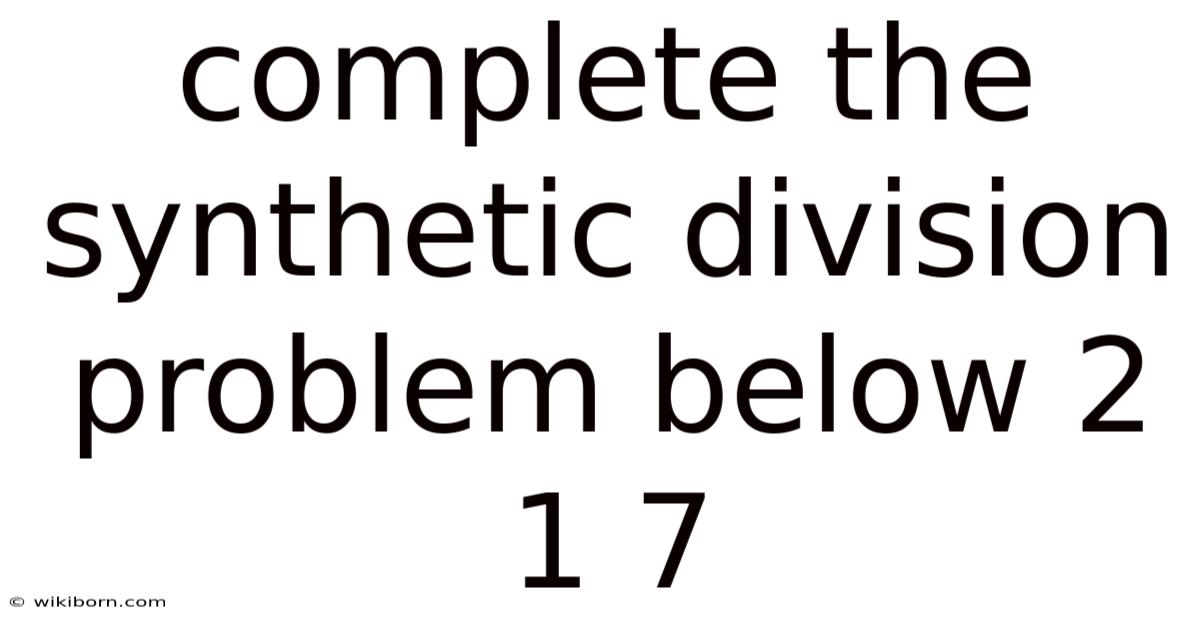
Set up the table: Write the coefficients of the polynomial (2, 1, 7) in a row. To the left, write the value of 'c' (2) enclosed in a box or parenthesis.
2 | 2 1 7 | |_________ -
Bring down the leading coefficient: Bring down the first coefficient (2) to the bottom row.
2 | 2 1 7 | |____2____ -
Multiply and add: Multiply the number in the bottom row (2) by 'c' (2), resulting in 4. Add this result to the next coefficient in the top row (1). Write the sum (5) in the bottom row That alone is useful..
2 | 2 1 7 | 4 |____2__5___ -
Repeat the process: Multiply the new number in the bottom row (5) by 'c' (2), resulting in 10. Add this to the next coefficient in the top row (7). Write the sum (17) in the bottom row.
2 | 2 1 7 | 4 10 |____2__5__17_ -
Interpret the result: The bottom row represents the coefficients of the quotient and the remainder. The last number (17) is the remainder. The numbers before it are the coefficients of the quotient. Since the original polynomial was of degree 2, the quotient is of degree 1 That's the part that actually makes a difference. But it adds up..
Because of this, dividing 2x² + x + 7 by (x - 2) yields a quotient of 2x + 5 and a remainder of 17. We can write this as:
2x² + x + 7 = (x - 2)(2x + 5) + 17
Example 2: Dividing 2x² + x + 7 by (x + 1)
Here, c = -1. Let's follow the same steps:
-
Set up the table:
-1| 2 1 7 | |_________ -
Bring down the leading coefficient:
-1| 2 1 7 | |____2____ -
Multiply and add:
-1| 2 1 7 | -2 |____2_-1___ -
Repeat the process:
-1| 2 1 7 | -2 1 |____2_-1__8_ -
Interpret the result:
Dividing 2x² + x + 7 by (x + 1) yields a quotient of 2x - 1 and a remainder of 8. This can be expressed as:
2x² + x + 7 = (x + 1)(2x - 1) + 8
Example 3: Dividing 2x² + x + 7 by (x - 0.5)
Here, c = 0.5. Let's proceed as before:
-
Set up the table:
0.5| 2 1 7 | |_________ -
Bring down the leading coefficient:
0.5| 2 1 7 | |____2____ -
Multiply and add:
0.5| 2 1 7 | 1 |____2__2___ -
Repeat the process:
0.Practically speaking, 5| 2 1 7 | 1 1. 5 |____2__2__8. -
Interpret the result:
The quotient is 2x + 2 and the remainder is 8.5. Therefore:
2x² + x + 7 = (x - 0.5)(2x + 2) + 8.5
The Significance of the Remainder
The remainder obtained through synthetic division is crucial. According to the Remainder Theorem, when a polynomial P(x) is divided by (x - c), the remainder is equal to P(c). In our examples:
- P(2) = 2(2)² + 2 + 7 = 17 (matches the remainder in Example 1)
- P(-1) = 2(-1)² + (-1) + 7 = 8 (matches the remainder in Example 2)
- P(0.5) = 2(0.5)² + 0.5 + 7 = 8.5 (matches the remainder in Example 3)
This connection between synthetic division and function evaluation is a powerful tool for quickly determining the value of a polynomial at a specific point Not complicated — just consistent..
Dealing with Missing Terms
What if the polynomial has missing terms? Think about it: for example, consider 3x³ + 2x + 5. Notice the absence of an x² term Simple, but easy to overlook..
Example 4: Dividing 3x³ + 2x + 5 by (x - 1) (c = 1)
-
Set up the table:
1 | 3 0 2 5 | |_________ -
Perform synthetic division: Remember to include the zero placeholder for the missing x² term.
1 | 3 0 2 5 | 3 3 5 |___3__3__5__10_ -
Interpret the result: The quotient is 3x² + 3x + 5, and the remainder is 10 Small thing, real impact..
Applications of Synthetic Division
Synthetic division has several important applications in algebra:
- Factoring Polynomials: If the remainder is zero, the divisor (x - c) is a factor of the polynomial.
- Finding Roots: The roots (or zeros) of a polynomial are the values of x that make the polynomial equal to zero. Synthetic division can help locate these roots.
- Polynomial Evaluation: As highlighted earlier, it provides a quick method for evaluating a polynomial at a given value.
- Partial Fraction Decomposition: This advanced technique in calculus uses synthetic division as a preliminary step to simplify rational functions.
Frequently Asked Questions (FAQ)
Q1: Can I use synthetic division for any polynomial division?
A1: No. On the flip side, synthetic division is specifically designed for dividing polynomials by linear factors of the form (x - c). For dividing by higher-degree polynomials, long division is necessary.
Q2: What if the remainder is zero?
A2: A zero remainder indicates that the divisor is a factor of the polynomial. This is extremely useful in factoring and root finding.
Q3: Can I use synthetic division with complex numbers?
A3: Yes, synthetic division works equally well with complex numbers as it does with real numbers. Still, this might require more attention to detail in calculations.
Q4: Are there any limitations to synthetic division?
A4: Synthetic division is best suited for linear divisors. Here's the thing — the method becomes cumbersome for higher-degree divisors, making long division the more appropriate method. Also, while efficient, it lacks the visual clarity of long division in explaining the steps.
Q5: How can I verify my answer?
A5: After performing synthetic division, verify your result by multiplying the quotient by the divisor and adding the remainder. This should yield the original polynomial Turns out it matters..
Conclusion
Synthetic division is a valuable tool in algebra, offering an efficient way to perform polynomial division, particularly when dividing by linear factors. On the flip side, remember to always check your work, and don't hesitate to practice different examples to solidify your understanding. By understanding the underlying principles and mastering the step-by-step process, you can confidently tackle various polynomial problems. But synthetic division simplifies complex calculations, making polynomial manipulation more accessible and efficient. The more you practice, the smoother and faster this powerful technique will become, enabling you to solve more complex algebraic problems with ease.
