Finding the Unknown: A Deep Dive into Solving Simple Algebraic Equations
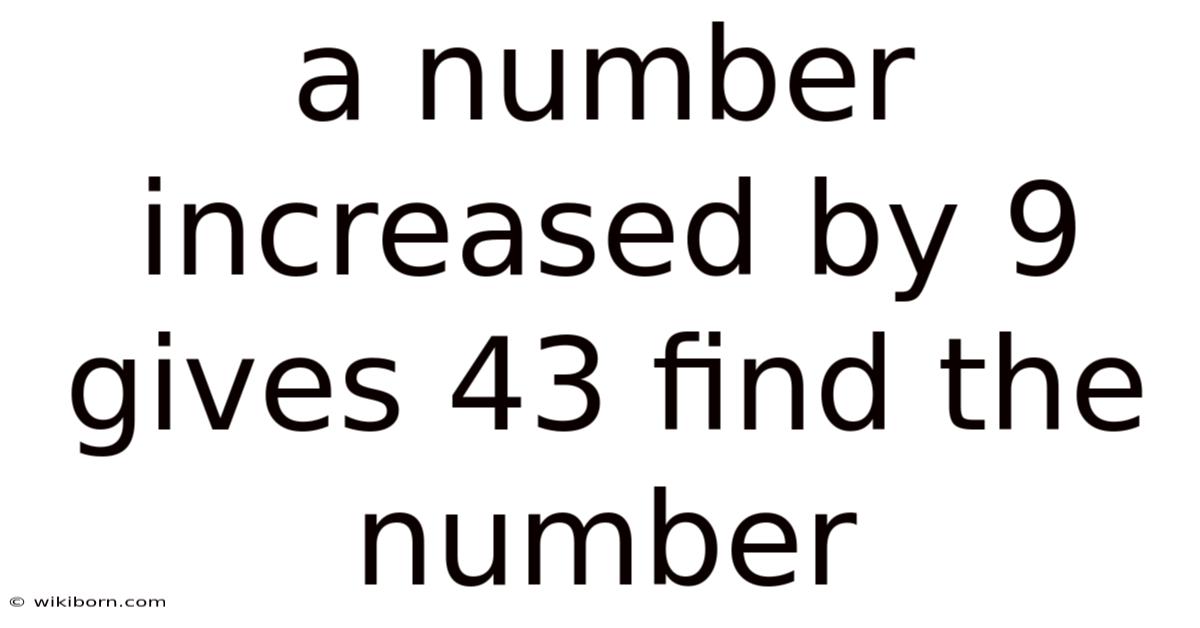
This article will guide you through solving the seemingly simple problem: "A number increased by 9 gives 43; find the number." While the solution might seem immediately obvious to some, we'll explore this problem in detail, revealing the underlying mathematical principles and expanding your understanding of algebraic equations. This journey will not only provide the answer but also equip you with the tools to solve similar problems, no matter how complex they become. We'll cover various methods, address common misconceptions, and even break down the historical context of solving such equations.
Introduction: Understanding the Problem
The problem statement, "A number increased by 9 gives 43; find the number," presents a fundamental algebraic equation. On top of that, this seemingly simple question forms the basis for understanding more complex algebraic concepts. Still, in essence, it's asking you to identify an unknown value (the "number") that, when added to 9, results in 43. In real terms, mastering this foundational problem will lay a strong groundwork for tackling more advanced mathematical challenges. The keywords associated with this problem include: algebraic equations, unknown variable, solving for x, and inverse operations Worth keeping that in mind. Surprisingly effective..
Method 1: Intuitive Subtraction
The most straightforward approach for many is to intuitively use subtraction. If a number plus 9 equals 43, then the number itself must be the difference between 43 and 9 Simple as that..
- Solution: 43 - 9 = 34
Which means, the number is 34. Think about it: this method relies on a basic understanding of arithmetic operations and their inverse relationships. Addition and subtraction are inverse operations; one undoes the other That's the part that actually makes a difference. Simple as that..
Method 2: Formal Algebraic Approach
While the intuitive method works well for this specific problem, a formal algebraic approach is essential for understanding more complex equations. Let's represent the unknown number with a variable, typically 'x'. The problem can be translated into an algebraic equation:
- Equation: x + 9 = 43
To solve for 'x', we need to isolate it on one side of the equation. This involves performing the inverse operation of addition, which is subtraction. We subtract 9 from both sides of the equation:
- Step 1: x + 9 - 9 = 43 - 9
This simplifies to:
- Step 2: x = 34
So, the solution, using the formal algebraic method, is also 34. This method is crucial because it provides a structured and generalized approach that can be applied to a wide range of algebraic problems, even those involving more than one operation or variable And that's really what it comes down to..
Method 3: Visual Representation
For a more visual understanding, consider using a number line. Start at 43 and move 9 units to the left (representing subtracting 9). This will land you at 34, visually demonstrating the solution. This approach is particularly helpful for students who benefit from visual aids in understanding mathematical concepts.
Expanding the Concept: Introducing More Complex Equations
The fundamental principle demonstrated here – isolating the variable using inverse operations – is applicable to much more complex algebraic equations. Let's consider some examples:
- Example 1: 2x + 5 = 11
Here, we first subtract 5 from both sides: 2x = 6. Then, we divide both sides by 2: x = 3.
- Example 2: 3x - 7 = 8
First, add 7 to both sides: 3x = 15. Then, divide both sides by 3: x = 5.
- Example 3: (x/2) + 4 = 10
First, subtract 4 from both sides: x/2 = 6. Then, multiply both sides by 2: x = 12.
These examples demonstrate the versatility of the inverse operations method. No matter how many operations are involved, the principle remains consistent: perform the inverse operations in the reverse order of the order of operations (PEMDAS/BODMAS) to isolate the variable.
Understanding Inverse Operations: A Deeper Dive
The success of solving algebraic equations hinges on a solid understanding of inverse operations. These are operations that "undo" each other. Here's a breakdown:
-
Addition and Subtraction: Adding a number and then subtracting the same number results in the original number. (e.g., 5 + 3 - 3 = 5)
-
Multiplication and Division: Multiplying a number and then dividing by the same number results in the original number. (e.g., 5 x 2 / 2 = 5)
-
Exponentiation and Roots: Raising a number to a power and then taking the corresponding root results in the original number. (e.g., 2² = 4, √4 = 2)
Common Mistakes and How to Avoid Them
Even in seemingly simple equations, certain mistakes can occur. Here are some common errors and how to prevent them:
-
Incorrect Order of Operations: Always follow the order of operations (PEMDAS/BODMAS) when simplifying expressions. Parentheses/Brackets, Exponents/Orders, Multiplication and Division (from left to right), Addition and Subtraction (from left to right).
-
Errors in Arithmetic: Double-check your calculations. Simple arithmetic mistakes can lead to incorrect solutions.
-
Forgetting to Apply Operations to Both Sides: Remember that whatever operation you perform on one side of the equation must be performed on the other side to maintain balance.
Historical Context: The Evolution of Solving Equations
Solving equations like x + 9 = 43 has a rich history. Practically speaking, while the methods might seem straightforward today, the development of algebraic notation and techniques took centuries. Early civilizations used various methods, often relying on geometric representations or rhetorical approaches (using words instead of symbols). The development of symbolic algebra, with its use of variables and operators, significantly simplified the process of solving equations and paved the way for more advanced mathematical concepts Not complicated — just consistent. Which is the point..
Frequently Asked Questions (FAQ)
Q: Can this problem be solved without using algebra?
A: Yes, as demonstrated in Method 1, the problem can be solved intuitively using subtraction. Even so, the algebraic approach provides a more generalized and powerful method for solving a broader range of problems.
Q: What if the problem involved more complex operations?
A: The principles remain the same. Use inverse operations to isolate the variable, following the order of operations Practical, not theoretical..
Q: What are some real-world applications of solving algebraic equations?
A: Algebraic equations are used extensively in various fields, including physics, engineering, finance, computer science, and many more. They are fundamental tools for modeling and solving real-world problems.
Q: How can I improve my skills in solving algebraic equations?
A: Practice is key. Start with simple problems and gradually work your way up to more complex ones. Use online resources, textbooks, and practice worksheets to build your skills Easy to understand, harder to ignore..
Conclusion: Mastering the Fundamentals
Solving the equation "A number increased by 9 gives 43; find the number" might seem trivial at first glance. Plus, remember, consistent practice and a solid understanding of the concepts are the keys to success in algebra and beyond. By understanding the underlying principles of inverse operations and applying the formal algebraic method, you've taken the first step towards mastering a fundamental skill applicable to a vast array of mathematical and real-world problems. Still, it serves as a powerful introduction to the world of algebra. The solution, 34, is not just a number; it's a gateway to a deeper understanding of mathematical reasoning and problem-solving.
